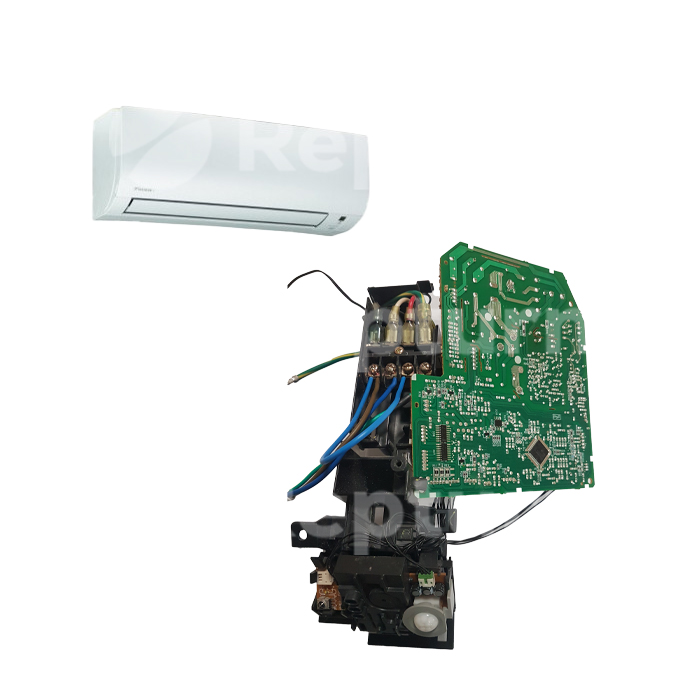
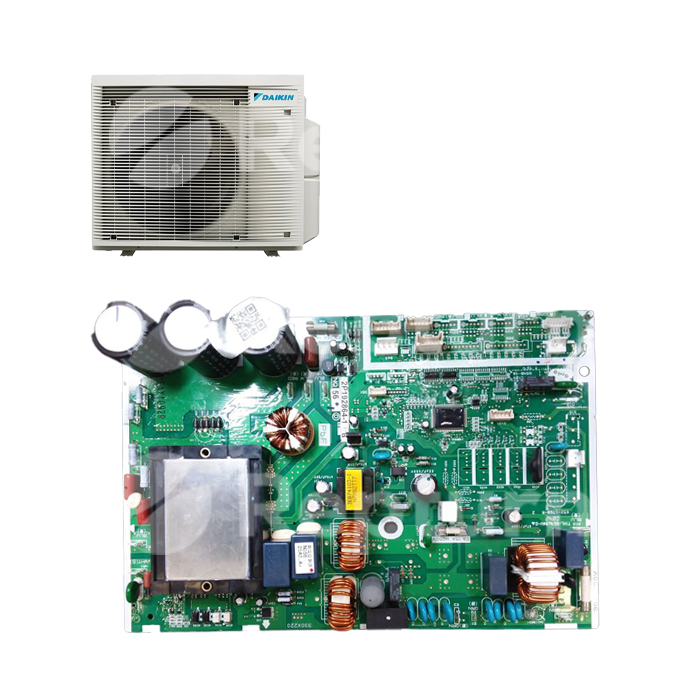
H7 and H2 fault codes on Daikin outdoor units: when is the fault electronic?

On Daikin outdoor units, certain fault codes are regularly encountered in the field. Among them, error codes H7 and H2 are among the most frequently encountered by plumbers and heating engineers when troubleshooting heat pumps and air conditioners.

These faults are often associated with a mechanical or power supply problem. However, in many cases, the real cause of the fault is electronic. In this case, the fault is located on the outdoor unit's circuit board.

This article will help you interpret these two fault codes and guide your diagnosis.

Image3
Sommaire

    What does the H7 code on a Daikin air conditioner mean?

    Fault code H7 corresponds to a problem with the outdoor unit's fan(s). Specifically, the electronic board detects that the fan is not responding as expected (speed, feedback, start-up). The H7 code does not automatically mean fan failure. On the unit, the most frequent symptoms are :

    • fan won't start
    • irregular or intermittent operation,
    • outdoor unit shutdown with H7 code display

    Checks to be carried out :

    ⚠️ Always work safely off and then on, except for step 3 "Inspect electrical system". Before suspecting an electronic component, we recommend that you carry out the following checks:

    Vérifier le ventilateur

    Vérifications
    • Le ventilateur tourne-t-il librement à la main ?
    • Pas de blocage mécanique (feuilles, glace, débris) ?
    • Pas de jeu excessif ou de bruit anormal ?
    Conclusions

    👉 Si le ventilateur est bloqué ou grippé → panne mécanique.

    👉 S’il tourne librement → contrôler les connecteurs.

    Contrôler les connecteurs

    Vérifications
    • Connecteur du moteur bien enfiché sur la carte ?
    • Pas de cosse brûlée, oxydée ou desserrée ?
    • Pas de fil coupé ou pincé ?
    Conclusions

    👉 Un faux contact peut suffire à déclencher un H7.

    Inspecter le système électrique

    Vérifications
    • Mettre l’installation sous tension.
    Conclusions

    Il y a une tension → la carte commande bien, le problème vient du ventilateur (moteur ou électronique intégrée).

    Il n’y a aucune tension alors que l’installation est alimentée → le ventilateur n’est pas en cause, la carte électronique ne commande plus.

    👉 À retenir : si la carte n’envoie rien au ventilateur, ce n’est pas le ventilateur le problème.

    Image2

    A faulty fan can damage the circuit board. A defective board, on the other hand, will not damage the fan.

    1. Check and replace fan(s) first.
    2. If the fault persists, have the circuit board repaired.

    The order of repair is therefore crucial: fan first, electronic board second.

    When can we talk about electronic failure?

    If the fan is operating correctly, the connections are correct and the control voltage is present, the H7 code usually comes from the outdoor unit's electronic board. In this case, the board is no longer controlling the fan correctly and needs to be repaired.

    What does the H2 error code on a PAC mean?

    The H2 code on a Daikin outdoor unit indicates a fault related to the power supply. Specifically, the electronic board detects a voltage, internal power supply or protection fault. It then switches the system to safety mode. Symptoms frequently encountered on equipment:

    • Outdoor unit completely inactive
    • As soon as the power supply is restored, the power switches off.
    • Failure following a power cut, micro outage or storm

    The checks to be carried out to ensure that the fault does not have another origin are :

    Vérifier l’alimentation générale de l’unité extérieure

    Vérifications
    • Contrôler la présence de tension à l’arrivée de l’UE.
    • Vérifier que la tension correspond bien aux valeurs attendues (mono ou tri).
    • S’assurer que le disjoncteur ne déclenche pas anormalement.
    Conclusions

    👉 Si aucune tension n’arrive → problème d’installation / réseau (pas électronique).

    Contrôler les fusibles

    Vérifications
    • Vérifier les fusibles présents sur l’unité extérieure.
    • Contrôler visuellement l’absence de traces de chauffe ou d’oxydation.
    • Vérifier la continuité des protections.
    Conclusions

    👉 Si un fusible est grillé, le remplacer.

    Vérifier la continuité et les connexions

    Vérifications
    • Contrôler le bornier d’alimentation.
    • Vérifier le serrage des connexions.
    • Observer l’état des câbles (pas de fil brûlé ou desserré).
    • Vérifier l’absence d’humidité ou d’infiltration dans l’UE.
    Conclusions

    👉 Si tout est conforme, on commence à s’éloigner d’un simple problème d’installation.

    Mesures simples au multimètre

    Vérifications
    • Sans démonter la carte, vérifier la présence de tension.
    • Contrôler qu’il n’y a pas de coupure franche d’alimentation interne.
    • S’assurer que la carte est alimentée mais ne réagit pas.
    Conclusions

    👉 Si tension OK mais défaut H2 → panne électronique très probable.

    When can we talk about electronic failure?

    When the power supply is present, but the outdoor unit fails to start or immediately goes into fault, the problem is generally not with the installation.

    In this case, the H2 code is very often linked to an electronic board failure. In this context, the motherboard is unable to manage or distribute the internal power supply correctly. It should therefore be replaced or repaired by a specialist.

    Image1

    What can we learn from H7 and H2 defects?

    H7 and H2 error codes on Daikin outdoor units are among the most frequently encountered in the field. Although they are often associated with mechanical or electrical faults, the electronic track should not be overlooked, particularly in the case of a faulty control board.

    By following a simple diagnostic method (fan, connectors, power supply, board), you can quickly identify the real source of the fault and avoid unnecessary replacements.

    If all seems well on the power supply and mechanical components side, it's highly likely that the electronic board is at fault, whether it's a control fault (H7) or an internal power supply problem (H2). In this case, a repair or board replacement will be necessary to restore system operation.

    H7 and H2 fault codes on Daikin outdoor units are often interpreted as mechanical or electrical faults. However, when basic checks are conclusive (fan working, connections sound, power supply compliant), the origin of the problem is very often electronic.

    In these situations, the outdoor unit control board no longer fulfils its role correctly: fan control for the H7, internal power supply management for the H2. Continuing to replace peripheral components without confirming the status of the board can lead to ineffective interventions, or even to after-sales returns.


    👉 If your field diagnosis clearly points to an electronic fault, you can consult our page dedicated to the repair of outdoor unit boards to find out more about which boards are supported and how.

    Frequently asked questions

    Quelle est la différence entre une climatisation réversible et une pompe à chaleur air-air ?

    Il n’y a aucune différence. Une climatisation réversible et une pompe à chaleur (PAC) air-air désignent le même système.

    On utilise simplement deux termes différents pour parler d’un appareil capable de chauffer et de rafraîchir l’air intérieur.

    Comment fonctionne une climatisation réversible (ou PAC air-air) ?

    Ce type d’installation fonctionne toujours avec deux unités :

    • Une unité intérieure, qui souffle de l’air chaud ou froid dans le logement
    • Une unité extérieure, qui capte la chaleur à l’extérieur ou la rejette selon le mode utilisé

    Les deux unités travaillent ensemble pour assurer le confort thermique toute l’année.

    Une PAC air-air, est-ce que ça chauffe aussi bien que ça rafraîchit ?

    Oui, une PAC air-air permet de chauffer en hiver et de rafraîchir en été, grâce au principe de la climatisation réversible.

    Quelle est la différence entre une PAC air-air et une PAC air-eau ?

    Il existe deux grands types de pompes à chaleur :

    • La PAC air-air : elle chauffe ou rafraîchit l’air à l’intérieur du logement
    • La PAC air-eau : elle chauffe de l’eau, utilisée pour les radiateurs, le plancher chauffant ou l’eau chaude sanitaire

    Dans ce cas précis, on parle uniquement de la PAC air-air / climatisation réversible.

    Est-ce qu’une climatisation réversible est forcément composée d’une unité extérieure ?

    Oui. Une climatisation réversible (PAC air-air) fonctionne toujours avec une unité extérieure, indispensable pour capter ou rejeter la chaleur.